
9th Circuit clarifies unfair advertising law
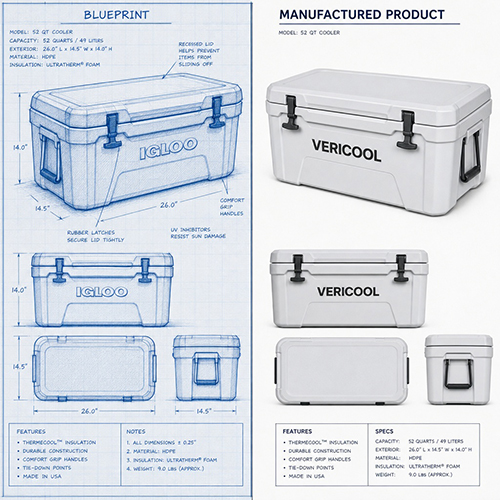
The 9th Circuit has narrowed the Lanham Act’s false advertising reach, holding that allegedly false claims about a product idea’s creative origin are not actionable under the statute.
In a case of first impression, the 9th Circuit Court of Appeal, in a split 2-1 decision, has ruled that a provision of the Federal Trademark law (Lanham Act) dealing with false advertising does not protect false claims concerning creative or originality claims as to the origin or source of the products. In In Vericool World, LLC v. Igloo Products Corp , 175 F.4th 1045 (9th Cir. 2026). 175 F.4th 1045 (9th Cir. 2026), the appeal court held that false claims relating to the “origin of an idea embodied” in a cooler do not concern the “nature, characteristics, qualities or geographic origin” of the product and are thus not actionable under the Lanham Act’s false advertising provision.
By way of background, Federal Trademark law 15 U.S.C. § 1125 sets forth laws governing ownership, registration and infringement of trademarks. A provision of that law, 15 U.S.C. § 1125(a)(1)(B), addresses false advertising and specifically prohibits false claims that “misrepresents the nature, characteristics, qualities, or geographic origin” of a good.
In Vericool , plaintiff Vericool and defendant Igloo both manufactured and sold eco-friendly coolers made of biodegradable material as an environmental improvement over the traditional coolers made of Styrofoam. The dispute arose when, in its marketing and advertising material, Igloo claimed that it was the first to bring such a product to the market, touting its product as “the world’s first eco sensitive cooler, made from 100% biodegradable materials.”
Vericool objected to Igloo’s claim of originality, pointing out that it had introduced its ecofriendly cooler to the market earlier than Igloo had. As recited by the Vericool decision, Vericool started manufacturing eco-friendly coolers and released its first fully biodegradable cooler composed of plant pulp in 2017, with retail sales starting in 2018. Igloo, on the other hand, launched its biodegradable cooler in 2019 after starting research in 2015 and having a ready prototype in 2017.
Faced with an impasse over their respective positions of being first, Vericool brought suit in Federal court under the Lanham Act against Igloo for false advertising. Igloo responded by moving for summary judgment, contending that the Lanham Act provision invoked by Vericool did not apply to claims of originality or creativity but to the tangible aspects of the product, which Vericool had not asserted as its basis for the suit. The district court judge granted Igloo’s motion, holding that Vericool’s claim was not actionable because it was about “the originalit and novelty of its own cooler design,” and, as such, belonged to the realm of intellectual property protection, rather than a false advertising provision of the Lanham Act. According t the district court summary judgment decision, Vericool had brought suit under trademark law because of its inability to sue for patent infringement.
As noted, the court of appeal split 2-1 on upholding the district court’s summary judgment ruling, with the dividing line between the appeal majority and dissent concerning whether the false advertising provision of the trademark laws applied to the dispute. To the majority, there was a clear dividing line between the unfair competitions’ provisions of the Lanham Act and other intellectual property laws, e.g., patent and copyright laws which deal with creation and originality. In support of its interpretation of 15 U.S.C. § 1125(a)(1)(B), the majority relied on a 2003 decision of the Supreme Court Dastar Corp. v. Twentieth Century Fox Film Corp . (2003) 539 U.S. 23, 37 ( Dastar ), for the proposition that “common law causes of action were not calibrated to protect the intellectual property behind the products themselves.” As explained by the court of appeal panel, in Dastar, the plaintiff claimed that the defendant had engaged in false advertising by claiming to be the producer of a video work that plaintiff had created many years before. The Supreme Court rejected that claim on the basis that the term ”origin of goods” in the Lanham Act was not intended to protect originality or creativity in the intellectual property sense of the phrase but referred to the producer of the product.
The Vericool appeal decision included a vigorous dissent, which disagreed with that narrow interpretation of the false advertising provision of the Lanham Act, contending that the plain meaning of the statutory words, the “nature,” “characteristics” or “qualities” of a product necessarily include intangible nature, characteristics or qualities of that product. The dissenting opinion reasoned that Vericool’s false advertising claim qualified as a valid claim under § 43(a)(1) (B) because the complained of misrepresentations concerned a historical attribute. In that regard, the dissent contended that the dispute over a product being “the first of its kind” is a distinctive historical feature that relates to the product’s nature and characteristic and is part and parcel of its appeal to the consuming public. In support of its interpretation of the statutory provision, the dissenting opinion pointed to the language of the statute, the public’s common understanding of what constitutes “nature, characteristics, and qualities,” none of which are limited to only tangible or observable features, and the Restatement (Third) of Unfair Competition, which cites many examples of false advertising involve intangible qualities, including misleading statements about the product’s source or origin.
Practitioner’s guide: The likely practical impact of the Vericool decision is creating a clearer line between the intellectual property features of a product or service and those dealing with functions and features of the products themselves. This distinction, in turn, will likely prompt more focus by product creators and manufacturers on timely protection of intellectual property aspects of their goods and services.
Dariush Adli | President